Why You Should Be Building Author Profiles for Your Expert Commentary Campaigns
Learn how author profiles help journalists verify experts, strengthen pitches and build trust for effective digital PR campaigns and stronger coverage.
 By Adam DochertyIndependent digital PR consultant, UK
- Published
- Reading time
- 5 min read
If you're running digital PR campaigns, there's a good chance journalists are looking at your expert with a raised eyebrow before they even read your pitch. Fake experts and AI-generated personas have made reporters cautious about who they feature, and that caution is landing on real experts too.
The fix is simple: build an author profile. A well-built one removes every bit of doubt a journalist might have about whether your expert is who you say they are, and whether they're worth quoting. If your client's site, or your own, doesn't have one yet, it should be top of the to-do list.
What are author profiles?
An author profile is a dedicated page (usually linked from every article and available on its own URL) that lays out who an expert is, what they know, and why they're worth listening to. Think of it as a credibility hub. It brings together a person's job title, background, qualifications, and track record in one place, so anyone checking them out doesn't have to go digging across five different websites to work out if they're legitimate.
For digital PR, this page becomes the single link you can point journalists to whenever you're pitching on behalf of an expert.
Why are author profiles important?
Journalists are under more pressure than ever to verify sources before publishing. With AI-generated content and invented personas creeping into inboxes, editors are tightening up who they'll feature and quote.
That means the burden of proof is now on the person pitching. If you can't quickly demonstrate that your expert is real, qualified, and credible, you're giving the journalist an easy reason to say no.
An author profile flips that. Instead of a journalist having to take your word for it, they can click through and see the evidence for themselves. It takes a pitch from a maybe to a yes, and it does a lot of that work before the journalist has even replied.
What does an author profile need?
The best author profiles I come across all tend to include the same core elements:
- Name and job role: who they are and what they do
- Photo: puts a real face to the name, which matters more than ever
- Years of experience: shows they've been doing this long enough to know their subject
- Qualifications and education background: backs up their expertise on paper
- Personal bio: short context on who they are beyond the job title
- Social links: LinkedIn, X, or wherever they're active, so journalists can cross-check them
- Recent media coverage: places they've already been quoted or featured
- Internal linking: links back to relevant content on the site, which also helps with SEO
That media coverage section is the one people underestimate. It's not just a nice-to-have. It shows a journalist this person has form. They've been trusted before by other publications, which makes it far easier to trust them again. If your expert has been quoted in a major outlet like Forbes, or won an industry award, that's exactly the kind of detail that should be front and centre. It's often the single strongest piece of validity you can offer.
My favourite author profile
If I had to point to one that gets it right, it's Bankrate.
Their author profiles are structured so cleanly that they tell a journalist everything they actually need to know, without any digging required. On one page you get the name and job title, links to socials, LinkedIn and email, years of experience in their field, education background, and a list of places they've already been cited.
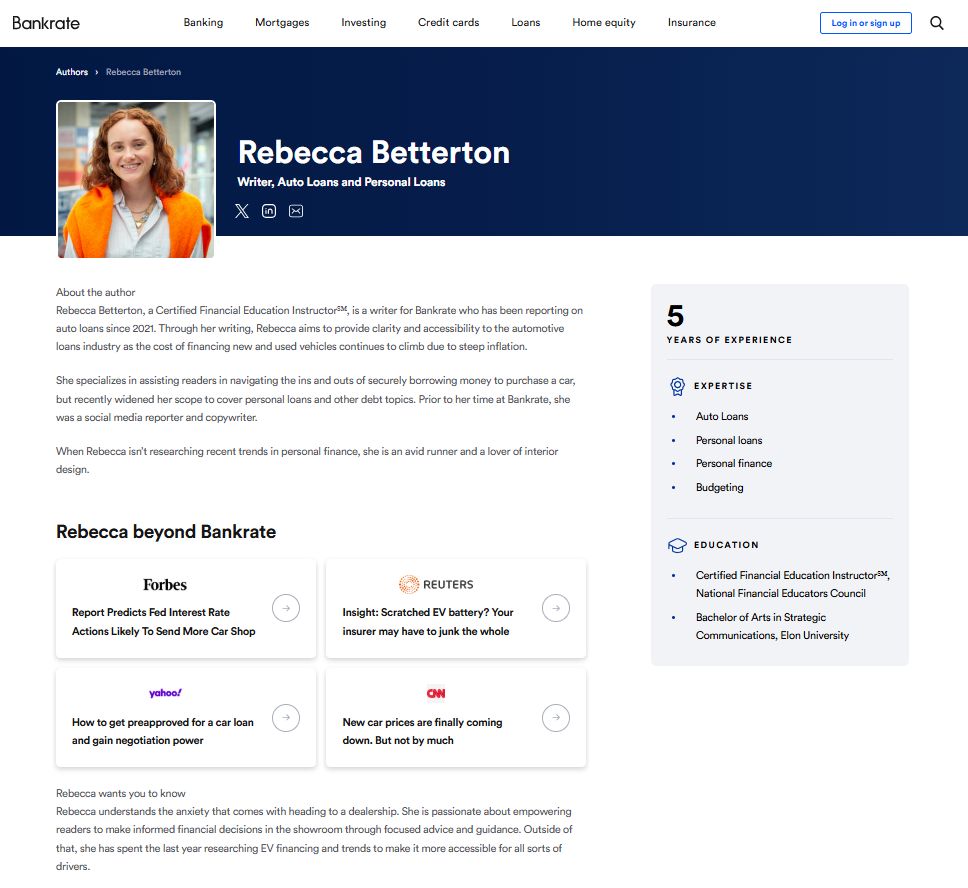
Nothing about the profile feels excessive or padded out for the sake of it. Every element earns its place, and together they build a picture of someone who's genuinely credible, not just someone claiming to be.
It's a good example of an author profile doing more than just existing. It's actively building trust.
What are fake experts?
This is the part of the digital PR world that's changed the most recently. Journalists have started receiving pitches with quotes attributed to people who simply don't exist, or who exist but didn't actually say what's being attributed to them. Some of this comes from AI tools generating convincing but entirely fabricated expert personas. Some of it is more old-fashioned: made-up job titles, invented credentials, or quotes dressed up to look like they came from a qualified source.
A common example is a made-up doctor giving medical commentary, complete with a fabricated title and background, when no such person actually holds that role anywhere. Journalists have been burned by this enough times that they're now far more likely to check before they publish.
This is exactly why author profiles matter so much right now. They're not just a nice addition to a website. They're becoming the best way for a journalist to satisfy themselves that the person they're about to quote is real, qualified, and worth their time.
How to use author profiles in your digital PR campaigns
The good news is that using an author profile in your campaigns doesn't require a complicated process. Once it exists, the simplest and most effective thing you can do is attach the link directly in your pitch email.
Rather than asking a journalist to trust your word that your expert is legitimate, you hand them the proof upfront. A quick line like "you can see [Name]'s background and previous media coverage here" followed by the link does the heavy lifting for you.
It saves the journalist time, it answers the credibility question before they've even asked it, and it puts your pitch ahead of the ones that offer no way to verify the person behind the quote.
In an environment where journalists are actively filtering out fake experts, that one link could be the difference between your pitch getting ignored and your expert getting featured.
Want results like this?
If you're looking to build genuine authority for your brand, earn coverage on high-authority UK publications, and start showing up where your customers are actually looking, whether that's Google, AI Overviews or ChatGPT, I'd love to help.